
A traditional will can explain who should inherit your property. It cannot, by itself, give anyone access to self-custodied Bitcoin. A court may order a bank or brokerage to transfer assets, but a blockchain accepts transactions signed with the correct private keys. Your estate plan therefore needs two parts: legal instructions for succession and a secure way to transfer the information needed to access your digital assets.
This does not make a traditional will unnecessary. It means that a will should not contain unencrypted seed phrases or serve as the only recovery plan. The legal document can identify assets and beneficiaries, while a separate, protected process handles cryptographic access.
Why Court Orders Cannot Unlock Self-Custodied Crypto
Many states have adopted laws that let fiduciaries request access to certain digital property. For example, the Connecticut Revised Uniform Fiduciary Access to Digital Assets Act can help an authorized representative manage online accounts, domains, and other services.
Those laws do not create a private key or change the rules of a blockchain. Self-custodied wallets rely on asymmetric cryptography. If an heir has the correct recovery information, they can sign a transaction. If that information is incomplete or missing, a court order cannot substitute for it.
A will can establish a beneficiary's legal right to an asset. It cannot replace the credentials required to move that asset on a blockchain.
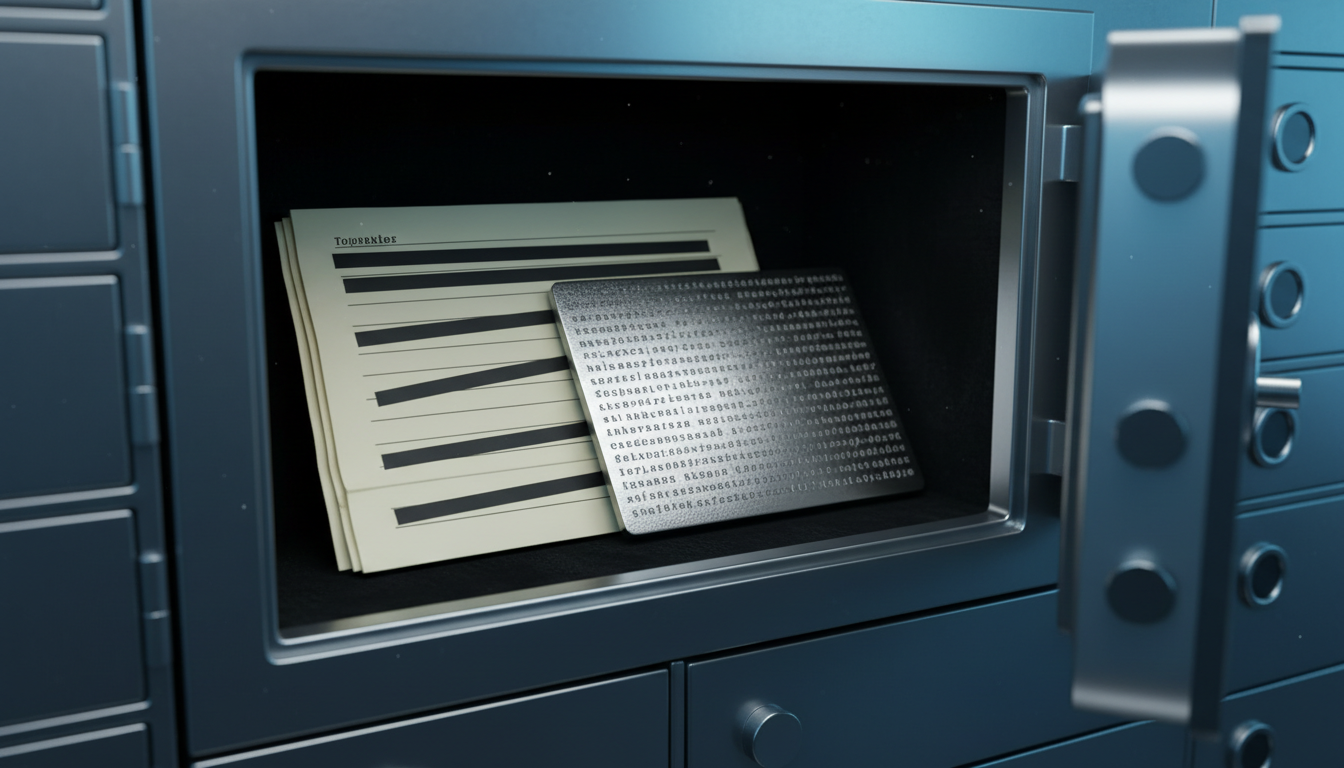
Putting a seed phrase in a will also creates a privacy and security problem. Wills may become accessible during probate, so anyone who obtains the document could gain the credentials needed to move the funds. Store sensitive recovery information separately and protect it with a process designed for digital assets.
Case Study: How an Incomplete Recovery Plan Failed
Consider David, a technology founder who held 45 Bitcoin in cold storage. He recorded a 24-word BIP39 recovery phrase on a fire- and water-resistant metal plate. He also worked with an estate attorney and placed the plate in a bank safe-deposit box. His will divided the assets between his spouse and two children.
The Missing Information
David died unexpectedly in a car accident. His executor and spouse obtained the safe-deposit box key and found the metal plate. The phrase did not restore the wallet, however, because David had also used a custom passphrase and a nonstandard derivation path. He had never documented either one.
For months, the family tried different devices and wallet settings. The Bitcoin remained visible on the blockchain, but they could not access it. The estate also had to consider tax and reporting obligations based on the assets listed in the will. This illustrates the central planning issue: recording ownership is not the same as providing a workable recovery path.
What Heirs Need to Know
A recovery phrase is only one part of a digital-asset plan. Heirs or executors may also need to know:
- Which wallet hardware and software to use.
- The relevant derivation path and any additional passphrase.
- Whether the assets use multisignature approval, a timelock, or another control.
- How to verify wallet software and avoid phishing or fake recovery tools.
Avoid leaving an unencrypted seed phrase, USB drive, or QR code with a law firm or in an ordinary cloud account. Legal responsibility does not eliminate the security risks of a compromised device, employee account, or backup.

Traditional Estate Planning vs. Cryptographic Access
The two systems address different parts of the inheritance process. Estate law establishes rights and responsibilities. Cryptographic controls determine whether a transaction can be signed.
| Transfer Element | Traditional Estate Planning | Cryptographic Reality |
|---|---|---|
| Authority and execution | A court can direct a bank or custodian to release property. | A valid private-key signature is required to move self-custodied funds. |
| Privacy | Probate documents may disclose assets and beneficiaries. | Recovery information can be kept separate and encrypted. |
| Reversal | A court or bank may be able to reverse or investigate a transaction. | Confirmed blockchain transactions are generally irreversible. |
| Intermediaries | Attorneys, custodians, and executors carry out instructions. | The owner must design a secure access and verification process. |
5 Common Crypto Inheritance Mistakes
- Including a seed phrase in the will: Probate records may expose credentials that should remain private.
- Giving hardware without instructions: A device is not useful if the beneficiary lacks its PIN, recovery information, or setup guidance.
- Relying on memory: Custom passphrases and derivation paths can be lost through illness, injury, or death.
- Ignoring liquidity and taxes: An estate may owe tax or other expenses even when heirs cannot yet access the crypto.
- Using insecure backups: Plaintext credentials in email, cloud storage, or an unencrypted drive create avoidable risks.
A Practical Solution for Digital Asset Inheritance
The goal is not to replace estate law. It is to connect the legal plan with a separate, secure process for transferring access information. A digital inheritance service can encrypt instructions, verify that a triggering event has occurred, and release information according to rules set by the owner.
A well-designed process should be non-custodial, limit what the service provider can see, and include regular check-ins and recovery tests. It should also allow the owner to update beneficiaries, wallets, and instructions as circumstances change. See our guide to using a dead man's switch for crypto inheritance for more on this approach.
Cipherwill is one option for organizing this process. It can help owners create an encrypted inheritance plan without taking custody of their assets. As with any estate-planning decision, review the arrangement with qualified legal and tax professionals in your jurisdiction.
Technical Checklist for Digital Asset Inheritance
- Create an asset inventory without putting seed phrases in the inventory itself.
- Record wallet models, account types, derivation paths, passphrases, and multisignature requirements in a protected location.
- Keep recovery information separate from the will and other public probate documents.
- Choose an executor or beneficiary who can follow basic wallet-security procedures.
- Discuss valuation, tax, and liquidity planning with qualified professionals.
- Test the recovery process periodically using a controlled procedure that does not expose the full credentials.
Update the plan after moving assets, changing wallets, adding a passphrase, or changing beneficiaries. A short, tested process is more useful than a detailed document that no one can follow.
Frequently Asked Questions
Question: Why can't my estate lawyer hold my recovery phrase?
Answer: A lawyer may be trustworthy, but their systems can still be compromised. Do not place an unencrypted seed phrase in a law firm's files; use a separate, protected access plan.
Question: Do I still need a traditional will?
Answer: Usually, yes. A will addresses guardianship, personal property, and legal distribution, while a separate crypto plan handles wallet access.
Question: Can a probate judge unlock my wallet?
Answer: A judge can issue orders concerning ownership and estate administration. The order cannot generate the private keys or passphrases required to sign a blockchain transaction.
Question: Is a 24-word seed phrase enough?
Answer: Not always. Beneficiaries may also need the wallet type, derivation path, PIN, passphrase, and any multisignature instructions.
Question: How does encryption protect beneficiaries?
Answer: Encryption keeps recovery instructions unreadable to unauthorized parties and, in some designs, to the service provider itself. Beneficiaries receive access only after the required verification steps.
Question: Could an estate owe taxes on inaccessible crypto?
Answer: Tax treatment depends on the jurisdiction and facts. Ask an estate or tax professional how to plan for valuation, reporting, and liquidity before finalizing your documents.
Question: How can a dead-man's switch avoid an accidental release?
Answer: Use regular check-ins, reminders, and independent verification. The plan should include a way to cancel or pause release if the owner is alive but temporarily unavailable.
By Cipherwill Editorial Team, Reviewed by Cipherwill Review Board, Trust & Security Review Team
Editorial contributor: Samarjeet Vohra
Review contributor: Reyansh Mehta